
Japan is a country that places high value on etiquette and manners, and this is especially evident on its dining culture and rules. When eating, the Japanese people are used to follow a strict set of eating etiquette and dining manners. These dining habits are universally accepted in the country, often unspoken yet widely recognized. For example, they usually slurp noodles to show their appreciation to the meal but avoid making chewing noises when eating other food. When eating sushi, they usually eat it in one bite. And they usually don’t eat while walking…
To ensure your enjoyable meal experience while traveling to Japan, we have created this complete guide on Japanese eating etiquette and table manners. From proper table manners, general eating habits and dos and don’ts to how to eat common dishes properly and FAQs, you can find all the essential information here.
Booking & Entering a Restaurant
Generally, restaurants in Japan can be categorized into three types based on their reservation policies: reservation-only restaurants (typically high-end restaurants or century-old restaurants), reservation-optional restaurants (typically more affordable eateries, it is safer to book ahead to avoid waiting in line), and no-reservation restaurants (most are casual dining spots or fast-casual restaurants).
At a fine-dining restaurant, making a reservation is considered basic etiquette. The restaurants usually confirm with you the time, number of people, whether there are ingredients to avoid, or special preparations needed. Apps like ableLog, TableCheck, Omakase, and Lavie Taste, are widely used in Japan for restaurant reservations.
Upon arrival at the restaurant, a dedicated staff member will greet guests at the entrance. At the entrance, menus and food models are often displayed, showing the dishes and prices. It is customary for customers to wait for the staff to escort them to their table.
Seating Arrangement in Japan
When visiting a traditional restaurant with a Japanese-style setting, guests need to remove their shoes before entering the dining area. You should place shoes neatly, with the toes facing outward.
The seating arrangements in these restaurants are also hierarchical. Typically, the eldest or highest-ranking person will take the seat first, while others should wait to be guided to their places. Sitting down on your own is considered impolite. In private settings, the host or superior will sit away from the door, while the person who is paying the bill or lower-ranking individuals usually sit nearer to the entrance.

Japanese Eating Etiquette – Proper Table Manners and Etiquette
Ordering at the Restaurant
When ordering food in the restaurant, you should wait for the waiter until he or she is near you, then gently say “すみません” (Excuse me) to get their attention. Also, you can raise your hand slightly and make eye contact to get their attention. Loud calls or dramatic gestures should be avoided as they are considered impolite. Also, you should avoid making the waiter wait, as it is considered troublesome and inconsiderate. So, call the waiter only when you’ve already decided what to order.
Pointing at the menu is perfectly acceptable when ordering. If you’re unsure of what to order, seeking the chef’s opinion is a respectful gesture in Japan.
Before starting your meal – Wipe Your Hands with Wet Towels
Before the meal, the restaurant will provide a wet towel to clean your hands. If the waiter hands the towel directly to you, the traditional Japanese eating etiquette is to receive it with one hand and switch to the other hand to hold it, then unfold the towel to wipe your hands. The towel is for cleaning your hands only. It is considered impolite if you use a wet towel for the mouth, face, or anything other than cleaning your hands.
If your fingers become dirty during the meal, clean them on the inner side of the towel where others cannot see. Fold the towel neatly and place it properly after using it.
Begin your meal by saying “Itadakimasu”
Starting to eat until all the dishes have been served. Before beginning your meal, it is customary to place your hands together and say “いただきます” (itadakimasu). This means you appreciate the food and people who provided it.

How to Use Chopsticks – Chopstick Etiquette and Taboos in Japan
Specific Steps to Use Chopsticks in Japan:
Step 1: Grip the middle of the chopsticks with your right hand. Hold them with your thumb, index, and middle fingers.
Step 2: Then, support the chopsticks from the bottom with your left hand. Smoothly move your right hand to the lower part.
Step 3: Switch your right hand to a comfortable position to finally grip the chopsticks properly, allowing you to use them effectively for eating.
General Japanese Chopstick Etiquette:
- If you need to take a break during a meal, you should rest the chopsticks horizontally on a chopstick rest (provided in most restaurants). Avoid having the tips of the chopsticks pointing at others.
- With no chopstick rest, you can alternatively place them diagonally next to your small plate. Don’t raise the tips of the chopsticks too high.
- After finishing your meal, place the chopsticks back in their original paper sleeve and slightly fold the top of the sleeve so the restaurant staff can identify that the chopsticks have been used. Or, you can just put them back on the chopstick rest.

Chopstick Taboos in Japan
Below are some chopstick etiquette mistakes that should be avoided during a meal in Japan:
- Avoid pausing indecisively while holding your chopsticks. Don’t fiddle with your chopsticks if you are not sure of which dish to pick.
- Don’t dig through the dish with your chopsticks to find your favorite food.
- It is rude to stab food with your chopsticks.
- Scooping food directly from your bowl is also not acceptable.
- Making noise by tapping your chopsticks on plates, bowls, or other utensils is also a disrespectful manner.
- Ensure you don’t pick up too much food at once. Get small, manageable portions.
- Never pass food directly from others with your chopsticks, since this mimics a funeral custom in Japan.
- Hold your chopsticks with your fingers, not with your palm.
- Be mindful to avoid dropping food or liquid from your chopsticks, as this is seen as careless.
- Don’t talk while holding your chopsticks.
- Pointing others with your chopsticks is also impolite.
- Take a bite before picking up more food. Don’t keep picking up food without eating.
Posture at the Dining Table
When dining at table seating or bar counter seating, you can maintain a regular and respectful posture as in most cultures. However, when dining on traditional tatami mats, special sitting postures and etiquette will be required.
- When entering a tatami room, it is customary to remove your hat, gloves, and shoes. But wearing socks is ok.
- The most formal sitting posture is seiza: Kneel with your knees together and sit back on your legs, with your hips resting on your heels.
- Agura is a more relaxed posture typically used by men: Sit cross-legged with your feet in front of you and hips on the mat.
- Yoko suwari is a more comfortable side-sitting posture for women: Extend your legs to one side, with the body not pressing on the feet.

Leaving no leftovers is good table manners in Japan
An important Japanese dining etiquette is encouraging people to finish all the food on their plates. This custom reflects a deep sense of gratitude for the food and for the person who prepared it. Leaving leftovers at a restaurant may be seen as a sign that the meal did not meet your expectations.
It doesn’t mean you need to force yourself to eat when you are truly full and cannot finish the meal. In this case, the Japanese diners usually apologize to the staff and thank the staff for preparing the meal.
After a meal
After finishing the meal, it is customary to express your gratitude by saying “ご馳走さまでした” (gochisousama deshita). It means “Thank you for the meal” or “It was a feast.” Tipping is not a requirement in most Japanese restaurants.
General Eating Habits of Japan
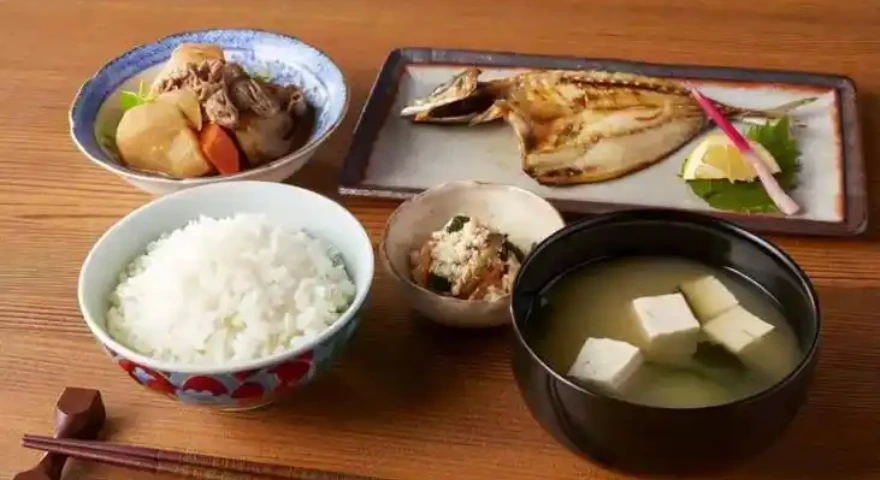
The basic structure of washoku is “ichiju-sansai” (一汁三菜), meaning one soup and three side dishes. Typically, they put the rice on the left, the soup on the right, main dishes like fried, steamed, or grilled foods at the back right, side dishes like stews or salads at the back left, and pickles in the center at the back.
Japanese eating etiquette emphasizes the importance of starting with food on the left. Thus, rice, as the main food in a traditional teishoku (set meal), is always placed on the left. In a kaiseki (multi-course) meal, it is also customary to begin with the dish placed on the left side of the tray.
In daily life, the sequence of eating is typically starting by sipping soup, followed by rice, the main dish, and then side dishes.
Eating loudly in Japan or making chewing noises are typically considered impolite. The only exception to this is with noodles, where slurping the noodles is encouraged.
How to Eat Popular Japanese Food Properly
How to Eat Sushi in Japan
In Japan, you should use your hands rather than chopsticks when eating sushi. The customary way is to pick the sushi up with your fingers and eat it in one bite. Don’t dip it into too much soy sauce to avoid the delicate flavor of fish being overwhelmed.
How to Eat Ramen and Udon Noodles
You’re encouraged to slurp noodles loudly when eating them in Japan, as it signifies that you like the flavor. But instead of eating the noodles immediately, you can take a moment to appreciate the dish’s appearance and smell the aroma before eating.
Typically, people will slurp the noodles directly from the bowl. To show your trust in the chef’s preparation, the polite way is to eat a few bites before adding seasonings according to your taste. When drinking the soup, it’s common to pick up the bowl and sip directly. Also, you can use a spoon to drink.
How to Eat Tempura
To ensure a delicate, crunchy exterior of the tempura, you’d better enjoy it fresh right after frying. When eating tempura, it is important to savor each bite, appreciating the texture and flavor piece by piece. Don’t stuff the food into your mouth at once.
The recommended order of eating tempura starts with lighter, more delicate flavors like vegetables and shrimp, then followed by stronger-tasting ingredients, like eel or fish.

How to Eat Rice in Japan
The etiquette to eat rice is to hold the rice bowl with your left hand and put the bowl close to your chest but not too near to your mouth. To hold the bowl, you can place your thumb on the rim and your index, middle, and ring fingers underneath the bowl for support. Use your right hand to pick up the chopsticks. Avoid rushing down food and placing side dishes on top of the rice directly.
How to Eat Sashimi
It is customary to dip sashimi lightly into soy sauce and wasabi. Bring the soy sauce plate close to your mouth, or use a piece of paper to prevent the soy sauce from dripping. Apply wasabi directly to the sashimi instead of mixing it into the soy sauce. Alternating between sashimi and shredded daikon radish and perilla leaves will help you fully enjoy the flavor of the fish. The order to enjoy sashimi is from left to right, then to center.
How to Drink Miso Soup
The common way to enjoy miso soup is to drink it directly from the bowl rather than using a spoon. Eat the ingredients in the soup with chopsticks. The miso soup features a thick consistency, and this eating method allows you a richer falvor experience of the soup.
Recommended Japan Tours:
Japanese Drinking Etiquette
- In Japan, people usually order drinks first before ordering food. They used to make a toast before beginning the meal.
- When offered a drink, you are expected to take a small sip even if you don’t drink alcohol. Or, you can turn you cup upside down to show that you’re not drinking.
- Don’t take a sip until everyone in your party raises their cups. Bring your glass to eye level when clinking glasses.
- A key point of Japanese drinking etiquette is that they never pour their own drink at the table. When two people are drinking together, it is customary to pour sake (Japanese rice wine) for the other person first and then allow others to pour for you.
- When receiving a drink, hold the cup with your right hand, with your left hand supporting it under the bottom.

FAQs for Dining in Japan
Is it acceptable to eat quickly in Japan?
Eating too quickly is considered impolite and against the dining etiquette of Japan. The proper way is to eat neither too fast nor too slow, to take small bites and chew thoroughly, and to stay in sync with others.
Can you eat on a bus or train in Japan?
Though no formal laws prohibiting eating or drinking on public transportation, eating food on subways and buses is generally not acceptable. If the subway carriage is not crowded and you won’t disturb others, you can quickly eat a snack with no strong smells.
Eating on airport buses is also not acceptable, but you can have some food at the station platform if you can get a seat.
On long-distance trains, such as JR, eating is usually allowed.
Drinking on public transportation is generally acceptable; just make sure you don’t disturb others and avoid drinking while facing other people.
What do Japanese people say before or after eating?
Before starting a meal, it is customary to say “いただきます (Itadakimasu),” which means “I will start eating now.” This is a way to express gratitude for the meal and the person who prepared the meal.
After finishing a meal, people usually say “ご馳走さまでした (Gochisousama deshita),” which means “Thank you for the meal, I have finished eating.”
Can you eat and walk in Japan?
A key dining etiquette in Japan is to not eat while walking. This is considered disruptive as the food may spill or drop and may disrupt the experience of those around you. Typically, there are designated eating areas available on Japan’s markets for people to finish their meals from the food vendors or festival stalls.
More Japan Travel Guides:





